
What is the Average Cost of a UK Wedding?
Page last updated: 18th June 2026
Each year, we analyse the data from thousands of wedding insurance policies to calculate the average cost of a UK wedding. Our dataset currently includes weddings from 2008 to 2028.
Many figures quoted by magazines and wedding planning websites are based on budgets shared long before the big day, when couples are still estimating what they expect to spend. By the time the wedding arrives, those budgets may have changed considerably.
Our figures are based on the actual level of cancellation cover couples choose when protecting their big day. That reflects real financial decisions - not just wishful thinking - and offers a more grounded view of average wedding spend.
The Average Cost of a UK Wedding in 2026
The average cost of weddings taking place in 2026 has fallen to £23,994, a 6.4% decrease from the 2025 figure of £25,625.
There are growing signs that average wedding spend may be levelling off.
Our latest data shows that for weddings taking place in 2026, the average cost currently stands at £23,994. This is a 6.4% decrease from the 2025 figure of £25,625 and is the first meaningful reduction in average wedding spend for many years.
When we first analysed weddings booked for 2026, early data indicated an average spend of £24,737. Even at that stage there were signs that the trend of rising wedding costs might be slowing. With significantly more data now available, the average has fallen further to £23,994, providing stronger evidence that wedding spending is levelling off after years of sustained growth.
Average wedding spend dropped to around £12,000 in the years following the 2008 financial crash, as couples reined in their budgets during a period of economic uncertainty. Over the following decade, costs rose steadily as confidence returned and continued to rise into the years immediately following the pandemic. Now, with signs of a slowdown, that long-term growth may finally be easing.
That doesn't mean couples have stopped spending. £25,000 is a significant sum and shows that weddings remain a major financial commitment for many couples. While the average spend may be stabilising, wedding budgets remain substantially higher than they were a decade ago.
Looking Ahead to 2027
Early data from weddings booked for 2027 suggests the average spend could rise to £25,893. This would represent a significant increase on the this year's figure, however, it's not dissimilar to spending levels seen in recent years and so indicates that wedding costs may now be settling, rather than increasing year on year.
“Last year, we suggested that wedding spending might be starting to level off, and the latest figures appear to support that view. Average wedding spend has fallen from £25,625 in 2025 to £23,994 for weddings taking place in 2026, marking the first significant drop we've seen for many years.
Early indications suggest we're entering a period of greater stability rather than seeing costs continue to rise year after year.”
Adam Leyton, CompareWeddingInsurance.org.uk
What Is the Cheapest Day to Get Married?
Monday weddings can cost around 20% less than the average. This represents a potential saving of over £5,000 compared to a typical Saturday wedding.
While Saturday remains the most popular day to get married, it isn't quite as dominant as it once was.
Ten years ago, around 55% of weddings took place on a Saturday. Looking at weddings taking place between 2024 and 2028, that figure has fallen to less than half. Couples today appear to be much more open to getting married on a weekday than they were a decade ago.
Some of that change may be a lasting effect of the pandemic. With venues facing huge demand as a result of so may weddings being postponed, couples often had to be more flexible with their dates. Even though those pressures have now eased, weekday weddings seem to have remained more popular than they were previously.
There is a clear difference in wedding spend between weekdays and weekends. Saturday weddings cost around 10% more than the average, while Monday weddings come in at around 20% below the average spend. Across all of the weddings we analysed, that's a difference of more than £5,000.
That doesn't necessarily mean couples can save £5,000 simply by moving their wedding to a Monday. Couples choosing a weekday wedding may be planning a different type of celebration or working to a different budget. The data does, however, show a clear link between the day of the week and overall wedding spend.
Weekend weddings are still the most popular choice, but weekday ceremonies are far more common than they used to be. For couples working to a budget, the day of the week they choose could have a bigger impact than they might expect.
What is the Cheapest Month to Get Married?
Weddings taking place in the winter months of November, January and February can be up to 16% cheaper than the average. This represents a huge saving of around £4,000.
We analysed the data further to see how the average wedding spend looks across the year.
It came as no surprise really to see that the more popular summer months of June to September were the more expensive with weddings in August costing around 7% more than the average.
With the exception of December and presumably Christmas weddings, the less popular winter months of November, January and February could be up to 16% cheaper. That's potentially a significant saving of around £4,000.
Compare wedding insurance cover and prices
Quickly compare wedding insurance cover from trusted UK providers in minutes
Compare Cover & Prices »Average wedding cost updates from previous years
With an average cost of £25,625, weddings in 2025 continue the upward trend in spending, though at a slower pace than the sharp increases seen just after the pandemic.
Between 2021 and 2022, costs rose by 6%, followed by an 11% jump from 2022 to 2023. Since then, the rate of increase has steadied, with a more modest 2.5% rise from 2023 to 2024, and 3.7% from 2024 to 2025.
In 2024, we thought the cost of living crisis might force couples to cut back - but that doesn't appear to be the case. Weddings still matter, and people are willing to spend to make the day special, even if they're a bit more careful about where the money goes.
For weddings scheduled to take place in 2024, the average cost is £24,710, up from £24,109 in 2023.
Our insight into average wedding spend is again derived from the data from the sale of over 1,600 wedding insurance policies, purchased to cover weddings that are scheduled to take place in 2024.
With inflation still at 8%, it was no surprise to see a further increase in the cost of getting married.
Following a dip after the financial crash of 2008, the cost of getting married has been steadily increasing every year for the past 12 years. However, the increase between 2023 and 2024 was a modest 3%, suggesting that average spend may be levelling off at around £25,000.
Given the current cost of living crisis, it's possible we'll see a decrease in the average spend on weddings in 2025.
For weddings scheduled to take place in 2023, the average cost is £24,109, a huge increase of 11%.
With inflation currently into double digits and, with some estimating it at over 20% by 2023, it wasn't a huge surprise to see a big jump in the cost of a 2023 wedding.
We looked at the data from over 5,000 wedding insurance policies, for weddings scheduled to take place in 2023 as well as in 2022, allowing us to revise our earlier figure.
Our last sample for 2022 was taken in April 2021 however, with more data available now, we have revised our average cost figure for 2022 to £21,725, a small increase of £1232.
For weddings scheduled to take place in 2023, the average cost then jumps nearly £2,500 to £24,109, a huge increase of 11%.
The increase in wedding spend between 2022 and 2023 is roughly in line with the most recently published CPI inflation figure of 10.1%, driven mostly by the increase in the cost of energy and food.
At nearly £25,000, the average cost of a wedding has now doubled over the past decade.
Despite the rising cost of living and cost of a wedding though, the number of couples tying the knot doesn't seem to be slowing. Our data shows a similar trend for 2022/23 sales as it did for 2021/22 suggesting as many couples are planning their wedding for next year as have this year.
Despite huge uncertainty caused by the ongoing coronavirus pandemic, the average cost of a UK wedding in 2021 and 2022 didn't show any sign of dropping.
COVID restrictions had resulted in tens of thousands of weddings being cancelled and, for those that were able to go ahead, often with significantly reduced guest numbers.
Yet despite all the uncertainty, couples were now ready to celebrate their big day in a big way!
The average wedding spend, based on the cancellation cover taken out on wedding insurance policies purchased via our comparison table increased by over £6,000 since we previously looked at the data in 2017.
For weddings scheduled to take place in 2021 and 2022, we found the average spend to be £20,493.
Following a dip in spending soon after the financial crisis of 2008, there has been an upward trend with the average in 2021 & 2022 looking to be higher than ever before, despite all the uncertainly caused by the coronavirus pandemic.
Notes on the data: Once again we analysed the data from a sample of over 1,500 wedding insurance policies purchased via our comparison table to cover weddings scheduled to take place in 2021 and 2022. Our figure for average wedding spend is based on the amount of insurance cover purchased in respect of complete cancellation of the wedding.
How much does the average UK wedding cost in 2012?
It seems the grim reality of the recession has affected even the most romantic event - weddings. It's not often that prices come down rather than going up, up and up, but that's what we're seeing with weddings. In 2008, the average cost of a UK wedding was over £20,000. However, in 2011 the average cost of getting married dropped by a massive 25% to £15,541 and in 2012 it will drop even further.
We studied the data from the sales of around 1,600 wedding insurance policies purchased to cover weddings taking place in 2012, via CompareWeddingInsurance.org.uk. We found that couples were purchasing policies to cover weddings for, on average, £11,441 of cover in respect of complete cancellation. Adding to this figure the £3,000 average cost of a honeymoon, this means that couples are spending, on average, £14,441 on getting married in 2012.
This figure represents a further £1,000 drop on the £5,000 decrease we saw in 2011.
It certainly came as quite a surprise to see such a drop last year. However, given the size of the sample and the fact that other sites (albeit with smaller samples) have also been reporting similar figures, we feel this is a very accurate reflection of average wedding budgets.
Regional Variations
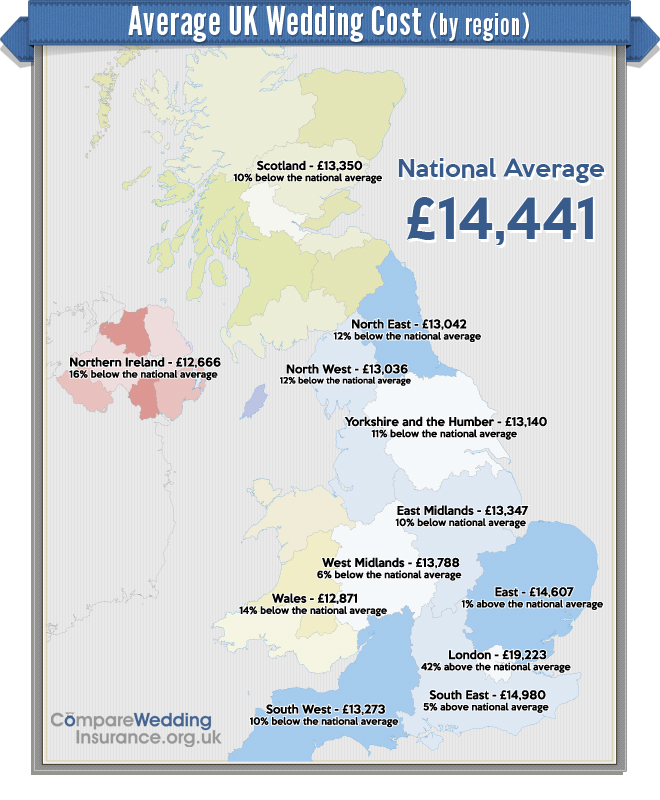 Having looked at the national average, we also broke the data down into geographic regions to see if couples in different parts of the UK are spending more or less on their weddings than others.
Perhaps unsurprisingly, couples in London and the South East are spending more on their weddings than those in other parts of the UK. However, we were surprised at just how much more couples in the capital are spending on getting married - 42% above the national average.
See our recent article on average wedding spend across all UK regions for the full breakdown on all regions.
Average Wedding Spend In 2013
We also have provisional figures for average wedding spend in 2013. Again this is based on the level of cover in respect of complete cancellation offered by wedding insurance policies purchased via CompareWeddingInsurance.org.uk for weddings taking place from January next year.
We're expecting to see a further drop of around 6% to an average cost of around £10,800 or £13,800 including the honeymoon.
Why Are Couples Spending Less Money On Their Weddings?
The global economic downturn has certainly played a large part in reducing wedding budgets. With general economic uncertainty and with credit to finance a wedding perhaps harder to find, couples are possibly being forced into cutting back.
We're seeing evidence of a reduction in guest numbers in an attempt to lower costs too. We're also seeing more couples going down the DIY route in an attempt to still have those little 'nice to have' extras but at a lower cost.
Where Does All This Money Go?
Despite nearly a £6,000 drop since 2010, a £14,500 average wedding budget is still a lot of money! So where does all this money go?
The reception usually accounts for the largest part of the budget, with couples spending around £4,000 on their venue and feeding their guests.
The bride's dress, groom's suit and other attendant's outfits can often add a further £2,000.
Then add the engagement ring, photographer, flowers, cake, transport, stationery and the cost of the stag/hen festivities and you can see how it's very easy to spend well over five figures!
Budgeting For Your Wedding
With an average cost of £25,625, weddings in 2025 continue the upward trend in spending, though at a slower pace than the sharp increases seen just after the pandemic.
Between 2021 and 2022, costs rose by 6%, followed by an 11% jump from 2022 to 2023. Since then, the rate of increase has steadied, with a more modest 2.5% rise from 2023 to 2024, and 3.7% from 2024 to 2025.
In 2024, we thought the cost of living crisis might force couples to cut back - but that doesn't appear to be the case. Weddings still matter, and people are willing to spend to make the day special, even if they're a bit more careful about where the money goes.
For weddings scheduled to take place in 2024, the average cost is £24,710, up from £24,109 in 2023.
Our insight into average wedding spend is again derived from the data from the sale of over 1,600 wedding insurance policies, purchased to cover weddings that are scheduled to take place in 2024.
With inflation still at 8%, it was no surprise to see a further increase in the cost of getting married.
Following a dip after the financial crash of 2008, the cost of getting married has been steadily increasing every year for the past 12 years. However, the increase between 2023 and 2024 was a modest 3%, suggesting that average spend may be levelling off at around £25,000.
Given the current cost of living crisis, it's possible we'll see a decrease in the average spend on weddings in 2025.
For weddings scheduled to take place in 2023, the average cost is £24,109, a huge increase of 11%.
With inflation currently into double digits and, with some estimating it at over 20% by 2023, it wasn't a huge surprise to see a big jump in the cost of a 2023 wedding.
We looked at the data from over 5,000 wedding insurance policies, for weddings scheduled to take place in 2023 as well as in 2022, allowing us to revise our earlier figure.
Our last sample for 2022 was taken in April 2021 however, with more data available now, we have revised our average cost figure for 2022 to £21,725, a small increase of £1232.
For weddings scheduled to take place in 2023, the average cost then jumps nearly £2,500 to £24,109, a huge increase of 11%.
The increase in wedding spend between 2022 and 2023 is roughly in line with the most recently published CPI inflation figure of 10.1%, driven mostly by the increase in the cost of energy and food.
At nearly £25,000, the average cost of a wedding has now doubled over the past decade.
Despite the rising cost of living and cost of a wedding though, the number of couples tying the knot doesn't seem to be slowing. Our data shows a similar trend for 2022/23 sales as it did for 2021/22 suggesting as many couples are planning their wedding for next year as have this year.
Despite huge uncertainty caused by the ongoing coronavirus pandemic, the average cost of a UK wedding in 2021 and 2022 didn't show any sign of dropping.
COVID restrictions had resulted in tens of thousands of weddings being cancelled and, for those that were able to go ahead, often with significantly reduced guest numbers.
Yet despite all the uncertainty, couples were now ready to celebrate their big day in a big way!
The average wedding spend, based on the cancellation cover taken out on wedding insurance policies purchased via our comparison table increased by over £6,000 since we previously looked at the data in 2017.
For weddings scheduled to take place in 2021 and 2022, we found the average spend to be £20,493.
Following a dip in spending soon after the financial crisis of 2008, there has been an upward trend with the average in 2021 & 2022 looking to be higher than ever before, despite all the uncertainly caused by the coronavirus pandemic.
Notes on the data: Once again we analysed the data from a sample of over 1,500 wedding insurance policies purchased via our comparison table to cover weddings scheduled to take place in 2021 and 2022. Our figure for average wedding spend is based on the amount of insurance cover purchased in respect of complete cancellation of the wedding.
How much does the average UK wedding cost in 2012?
It seems the grim reality of the recession has affected even the most romantic event - weddings. It's not often that prices come down rather than going up, up and up, but that's what we're seeing with weddings. In 2008, the average cost of a UK wedding was over £20,000. However, in 2011 the average cost of getting married dropped by a massive 25% to £15,541 and in 2012 it will drop even further.
We studied the data from the sales of around 1,600 wedding insurance policies purchased to cover weddings taking place in 2012, via CompareWeddingInsurance.org.uk. We found that couples were purchasing policies to cover weddings for, on average, £11,441 of cover in respect of complete cancellation. Adding to this figure the £3,000 average cost of a honeymoon, this means that couples are spending, on average, £14,441 on getting married in 2012.
This figure represents a further £1,000 drop on the £5,000 decrease we saw in 2011.
It certainly came as quite a surprise to see such a drop last year. However, given the size of the sample and the fact that other sites (albeit with smaller samples) have also been reporting similar figures, we feel this is a very accurate reflection of average wedding budgets.
Regional Variations
Having looked at the national average, we also broke the data down into geographic regions to see if couples in different parts of the UK are spending more or less on their weddings than others.
Perhaps unsurprisingly, couples in London and the South East are spending more on their weddings than those in other parts of the UK. However, we were surprised at just how much more couples in the capital are spending on getting married - 42% above the national average.
See our recent article on average wedding spend across all UK regions for the full breakdown on all regions.
Average Wedding Spend In 2013
We also have provisional figures for average wedding spend in 2013. Again this is based on the level of cover in respect of complete cancellation offered by wedding insurance policies purchased via CompareWeddingInsurance.org.uk for weddings taking place from January next year.
We're expecting to see a further drop of around 6% to an average cost of around £10,800 or £13,800 including the honeymoon.
Why Are Couples Spending Less Money On Their Weddings?
The global economic downturn has certainly played a large part in reducing wedding budgets. With general economic uncertainty and with credit to finance a wedding perhaps harder to find, couples are possibly being forced into cutting back.
We're seeing evidence of a reduction in guest numbers in an attempt to lower costs too. We're also seeing more couples going down the DIY route in an attempt to still have those little 'nice to have' extras but at a lower cost.
Where Does All This Money Go?
Despite nearly a £6,000 drop since 2010, a £14,500 average wedding budget is still a lot of money! So where does all this money go?
The reception usually accounts for the largest part of the budget, with couples spending around £4,000 on their venue and feeding their guests.
The bride's dress, groom's suit and other attendant's outfits can often add a further £2,000.
Then add the engagement ring, photographer, flowers, cake, transport, stationery and the cost of the stag/hen festivities and you can see how it's very easy to spend well over five figures!
Once you've set your budget you then need to stick to it! Keep your budget estimate in an accessible place - either electronically or in a notebook, whichever appeals to you more and update with real figures as you book suppliers and purchase wedding items. It might be a good idea to keep some budget back as contingency in case you find something irresistible that you hadn't planned on.
Wedding Insurance
Whatever you spend on your wedding, you'll want to make sure you avoid paying for items twice - if there's problem with your wedding dress or the venue goes bankrupt you'll want the reassurance of wedding insurance. If it's covered by your policy, wedding insurance will then pay for the replacement items so that you don't slip over your budget. At an average of £25,000, your wedding is still likely to be the second or third most expensive purchase you'll ever make!
Wedding insurance can cover things like:
- one of your suppliers going out of business
- damage to your dress or other attire
- death/illness of the bride, groom or member of close family
- loss of wedding photography
It's not that expensive either with policies starting from around just £30. To find out more about wedding insurance, see our FAQs and see our comparison table for a list of the prices and cover offered by a range of major providers.
Please note: The figures quoted on this page don't include the cost of the honeymoon, which is generally excluded from wedding insurance cover and therefore not part of our data.
About the Data
Each year thousands of couples purchase wedding insurance through CompareWeddingInsurance.org.uk. The data from those policies allows us to track how wedding spending changes over time.
Our average wedding cost figures are based on the level of cancellation cover couples choose when protecting their wedding. In most cases, this reflects the amount they would need to recover if their wedding had to be cancelled before it takes place.
Many wedding cost studies rely on surveys or estimates provided by couples. We take a different approach. Rather than asking people what they expect to spend, we're looking at the value they choose to insure, based on a real financial decision.
The data covers weddings taking place between 2008 and 2028 and is updated regularly. As well as calculating the average cost of a UK wedding, it allows us to track longer-term trends and compare spending by factors such as the month or day of the week a wedding takes place.
No single dataset can perfectly represent every wedding in the UK. However, we believe this provides one of the most comprehensive and reliable long-term views of how wedding spending has changed over the past two decades.
Unless otherwise stated, all figures and analysis on this page are based on CompareWeddingInsurance.org.uk's own wedding insurance data.
Using our Data
We welcome journalists, bloggers and researchers referencing our wedding cost figures. Please credit CompareWeddingInsurance.org.uk and include a link to this page as the original source.
Media Coverage
Our independent wedding cost research has been cited by national media including the BBC, Financial Times and The Guardian, as well as a wide range of regional and industry publications and websites.




Compare wedding insurance cover and prices
Quickly compare wedding insurance cover from trusted UK providers in minutes
Compare Cover & Prices »CompareWeddingInsurance.org.uk is a trading name of Leyton Solutions Limited.
Registered in England and Wales, Company number 7022117. Registered address: 86-90 Paul Street, London, EC2A 4NE.
Leyton Solutions Limited is an Introducer Appointed Representative of Caledon MGA Ltd, Emerald Life Limited, Innovative Risk Labs Ltd, Insuremore Ltd and UK Oasis Group Ltd who are all authorised and regulated by the Financial Conduct Authority.
Home | Blog | Sitemap | Privacy Policy | Contact


